
Celestia Chip Shines at CHIPNATION 2025: Reinforcing Canarian Leadership in Semiconductors
Las Palmas de Gran Canaria, December 2025 | Celestia Chip | Grupo Celestia
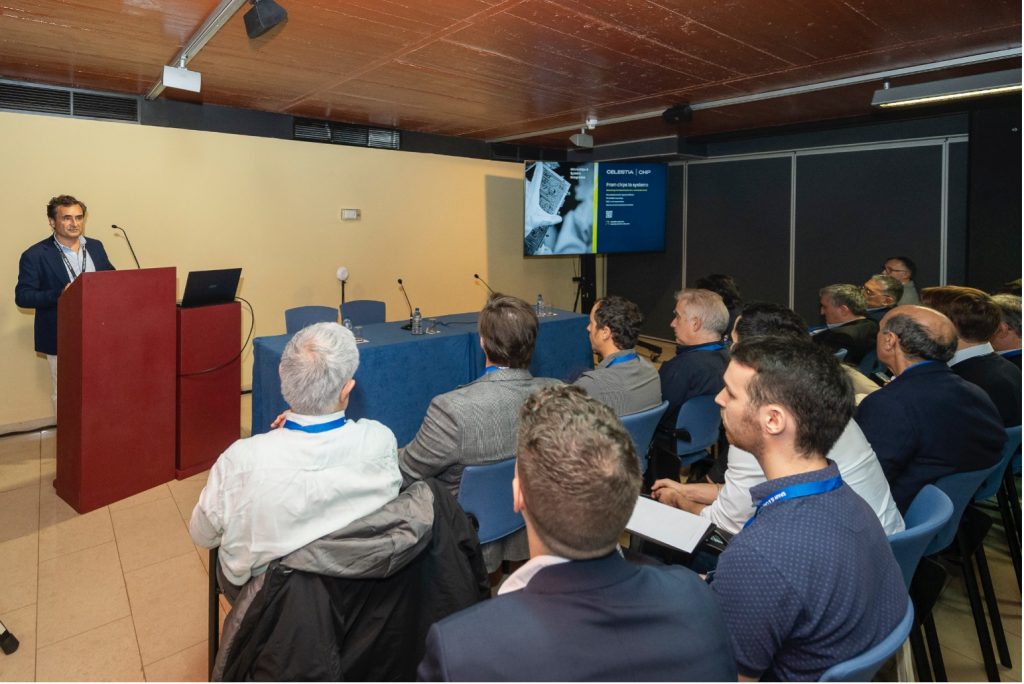
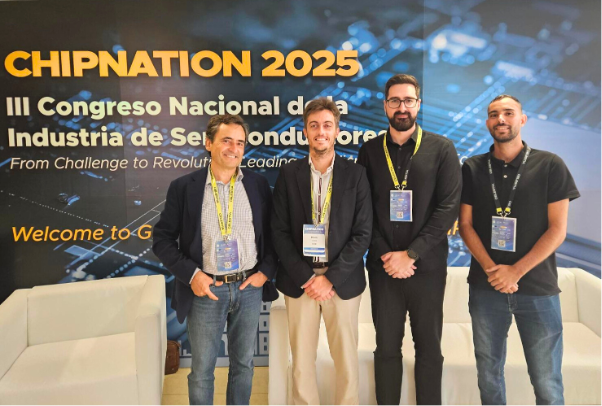
Celestia Chip took an active role in the 3rd National Congress of the Semiconductor Industry, CHIPNATION 2025, held from 3 to 5 December at the Auditorio Alfredo Kraus in Las Palmas de Gran Canaria. As a key member of the Clúster Chip Canarias and part of Grupo Celestia, the company showcased its latest advances in RFIC, MMIC, and RISC-V microcontroller design for space, defence, and satcom applications.
Organised by the Spanish Semiconductor Industry Association (AESEMI) with the support of the Government of the Canary Islands and the Cabildo de Gran Canaria, the event brought together more than 400 professionals from across Spain and leading international institutions, consolidating Las Palmas de Gran Canaria as the national epicentre of microelectronics.
A Showcase for Canarian Innovation
Under the motto «From chips to systems. From R&D to Impact,” Celestia Chip presented its capabilities in GaN, GaAs and advanced process technologies for IoT and critical systems. The event provided an ideal platform to advance strategic partnerships with key industry players such as Siemens, IMEC, and KD, also present at the congress.
The participation reinforced Celestia Chip’s integration within Grupo Celestia and its ongoing collaboration with the Applied Microelectronics University Institute (IUMA) of the Universidad de Las Palmas de Gran Canaria — one of the foundational pillars of the Canarian semiconductor ecosystem.
European Projects at the Heart of the Debate
CHIPNATION 2025 also served as a stage to highlight Celestia Chip’s involvement in high-impact European innovation projects. Two initiatives stand out:
• RISCCOM: Celestia Chip is leading the design of a UWB transceiver in 22 nm FDSOI technology for secure, low-power wireless communications built on open-source RISC-V architecture. Co-funded by the CDTI, the Spanish Ministry of Science, and NextGenerationEU funds through the PERTE Chip framework, RISCCOM develops multi-purpose systems with advanced cybersecurity capabilities. A core strategic goal of the project is reducing Europe’s dependence on Asian semiconductors — contributing to the EU target of reaching 20% of global chip production by 2030.
• RHEIN: In RHEIN, Celestia Chip applies GaN technology to develop next-generation microelectronics that integrate RF/mixed-signal frontends with embedded computing — targeting secure, low-power communications for industrial and mission-critical environments. This approach extends the «chips to systems» vision pioneered in RISCCOM, and is fully aligned with both the PERTE Chip framework and CDTI funding mechanisms to accelerate technology transfer and adoption across the EU.
Both initiatives reflect the company’s firm commitment to European technological sovereignty — one of the central themes running through all discussions at the congress.
The Canary Islands: Europe’s Emerging Chip Hub
The congress highlighted the strength of the Canarian microelectronics ecosystem. The Clúster Chip Canarias, of which Celestia Chip is a cornerstone member, brings together 14 companies generating over 200 highly skilled jobs and a combined turnover of between 35 and 40 million euros, with more than 500 million euros in active projects.
Braulio Quintana, Secretary of AESEMI and President of the Clúster Chip Canarias, underlined the need for sustained public support for the sector, noting the high investment levels and long development timelines that characterise microelectronics projects.
The AESEMI president also highlighted the lessons learned from the COVID-19 pandemic — when chip shortages brought European automotive production to a halt — and more recently, from rising geopolitical tensions, stressing that Europe must achieve strategic independence or at minimum, genuine negotiating capacity. In this context, the upcoming European Chip Act 2.0, expected early in 2026, was presented as a potential lifeline for the industry.
Celestia Chip’s Voice at CHIPNATION
«As CEO of Celestia Chip, it has been an honour to be part of Chipnation 2025 and to connect with so many brilliant minds shaping the next generation of semiconductor technology. I say goodbye until the next edition hoping that two key messages have resonated: the need to ensure strong, predictable, continuous and long-term funding for microelectronics, and the crucial role that universities and talent will play in the future of the sector.»
«This edition reinforces our belief that what we are building here matters — for industry, for Europe’s technological sovereignty, and for the next generation of engineers who will take microelectronics even further.»
— Fran Alcalá, CEO, Celestia Chip
Looking Ahead
As CHIPNATION 2025 drew to a close, Celestia Chip looks to the future with renewed momentum. Building on the relationships forged and opportunities identified at the congress, the company is positioned to continue leading innovation from the Canary Islands — accelerating technology transfer through the PERTE Chip framework and expanding its presence in high-value global markets.
From space to defence, from satcom to secure communications, Celestia Chip is proving that world-class semiconductor design can come from Europe — and that the chips being designed in the Canary Islands today will power the connected systems of tomorrow.
About Celestia Chip
Celestia Chip is a semiconductor design company based in the Canary Islands, Spain, part of Grupo Celestia. Specialising in RFIC, MMIC and RISC-V microcontroller design for space, defence and satcom markets, the company is a key member of the Clúster Chip Canarias and an active participant in European R&D programmes including RISCCOM and RHEIN.
Enlaces externos:
https://www.canarychip.es/
https://www.iuma.ulpgc.es/
https://aesemi.org/
Chipnation: https://congreso.aesemi.org/
Enlaces internos: /celestia-chip/our-projects/